How Was Ink Invented and When Did It Originate?
You use ink daily, but did you know it was invented thousands of years ago? Early civilizations like the Egyptians and Chinese created ink to record important information. They mixed natural materials such as soot, plant extracts, and gums with water to make writing substances that lasted.
Ancient Egyptians used black and red inks on papyrus, while Chinese dynasties developed ink sticks for better quality. Over time, ink evolved with new ingredients and techniques.
If you explore further, you’ll see how these innovations shaped culture and communication in amazing ways. It’s pretty cool to think about how something so common today has such a rich history!
Key Takeaways
- Ink originated in ancient civilizations like Egypt and China for recording communication, laws, and culture on materials such as papyrus and silk. Early inks were made by mixing natural pigments like soot or charcoal with liquids such as water or animal fats for flow and adhesion.
- Ancient Egypt developed durable black ink from soot and gum arabic, and used red ochre for important text highlights. It was a clever way to make writing stand out and last longer.
- Chinese dynasties innovated by creating solid ink sticks from soot and animal glue, enhancing portability and ink quality. This made writing easier to carry around and use wherever they went.
- Medieval inks used oak galls and iron salts to produce permanent dark pigments, aiding manuscript preservation and artistic illumination. It helped keep important documents safe and beautiful over time.
Early Uses of Ink in Ancient Civilizations
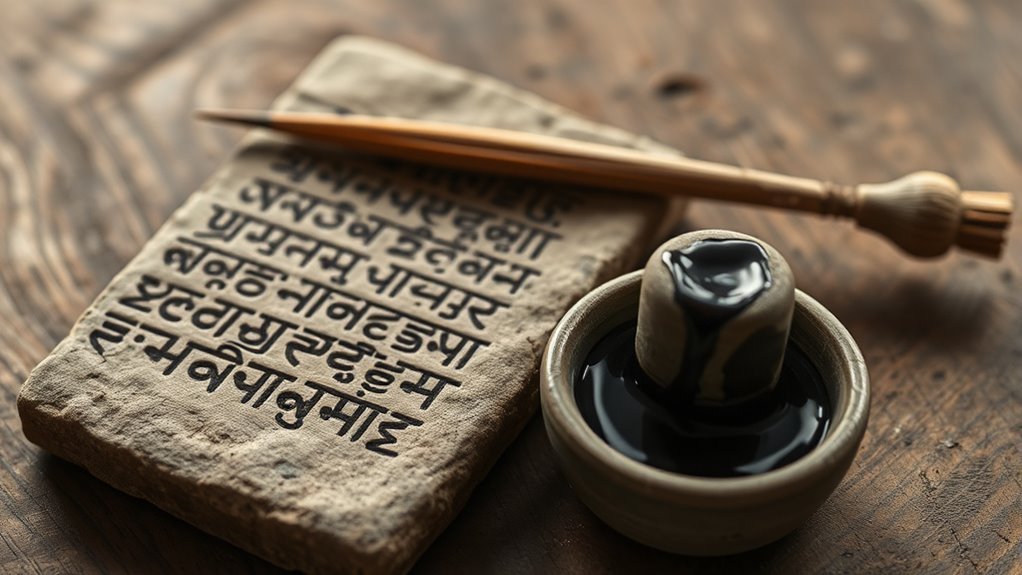
Exploring ancient civilizations reveals how early humans used ink to communicate and record information. You’d find that ink wasn’t just for writing; it played a key role in documenting laws, religious texts, and trade records.
In Egypt, scribes used ink to write hieroglyphics on papyrus, preserving history and culture. Meanwhile, in China, ink helped record philosophical ideas and government decrees, shaping society’s foundation.
You can appreciate how these early uses of ink made complex communication possible across distances and generations. The ability to record and share knowledge transformed societies, allowing you to trace ideas, events, and innovations.
Ink’s early role went beyond simple marks—it became a powerful tool for connection and legacy in ancient times.
Materials and Ingredients in the First Inks

How did ancient people create the inks that brought their words and images to life? They mixed natural materials to form the earliest inks, combining pigments with liquids to guarantee flow and adhesion.
You’d find that these primitive inks relied on simple, accessible ingredients.
Common components included:
- Soot or charcoal, providing dark pigments
- Plant extracts, offering various colors and binding properties
- Gum arabic or tree resins, acting as thickening agents
- Water or animal fats, serving as solvents to blend ingredients
Ink Development in Ancient Egypt and Mesopotamia
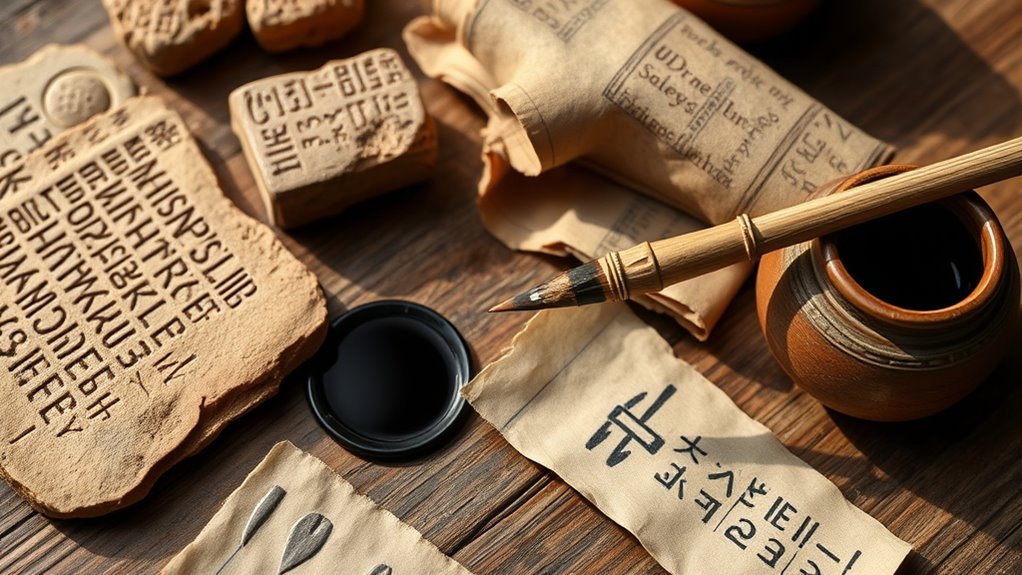
When you look at the ancient civilizations of Egypt and Mesopotamia, you’ll see they played a crucial role in advancing ink technology. In Egypt, scribes developed ink made from soot and gum arabic, creating a durable black ink for writing on papyrus.
They also experimented with red ochre to make red ink, used for headings and important words. Meanwhile, Mesopotamians mixed water, soot, and vegetable gum to produce ink for cuneiform inscriptions on clay tablets.
These inks had to be both permanent and practical for their writing materials. By refining ink formulas and adapting them to their writing surfaces, these civilizations set the foundation for future ink innovations.
This helped preserve their history and culture through written records you can still study today. Pretty impressive, right?
Innovations in Ink During the Chinese Dynasties
Although ancient Egypt and Mesopotamia laid the groundwork for ink, Chinese dynasties took ink-making to new heights by developing refined formulas and techniques that improved quality and usability. When you explore these innovations, you’ll see how Chinese ink became central to calligraphy and art.
You’ll appreciate the invention of solid ink sticks, allowing easy transport and long shelf life. Plus, the use of soot from pine or oil lamps mixed with animal glue for deeper, richer black ink really changed the game.
The Tang dynasty’s advancement of ink grinding helped artists control consistency and darkness better than before. Then, during the Song dynasty, there was exciting experimentation with colored inks, which expanded artistic expression even more.
These improvements made ink more versatile and durable, influencing writing and painting for centuries. You’d notice how these innovations still impact traditional Chinese art today.
Ink Evolution in the Medieval Period
You’ll find that medieval ink relied on unique ingredients, blending natural materials to create vivid colors.
As you explore manuscript illumination techniques, you’ll see how artists used these inks to bring texts to life.
Let’s examine how these developments shaped the art and craft of writing during this period.
Medieval Ink Ingredients
As scribes refined their craft during the medieval period, they relied on ink recipes that balanced availability and durability. You’d find that these inks needed to withstand time and frequent handling, so their ingredients were carefully selected.
Common components included oak galls, which provided tannic acid that darkened ink and improved permanence. Iron salts, usually iron sulfate, reacted with tannins to form a deep black pigment.
Then there was gum arabic, acting as a binder to thicken the liquid and help it stick to parchment. And of course, water served as the solvent, dissolving and mixing the ingredients evenly.
Manuscript Illumination Techniques
How did medieval artists transform simple inks into vibrant manuscript illuminations? They cleverly combined natural pigments with ink to create striking colors that brought texts to life.
You’d start by mixing ground minerals, plants, or even insects with a binding agent like egg white or gum arabic. This mixture adhered to the parchment, ensuring vivid hues didn’t fade.
Gold leaf was often added for a shimmering effect, applied carefully with a sticky substance called gesso. Artists used fine brushes to detail intricate patterns, borders, and miniature scenes.
These details enhanced both the aesthetic and spiritual value of manuscripts. By mastering these techniques, you’d contribute to preserving knowledge and art in a visually enthralling way.
It really shows how ink evolved from mere writing tools to dynamic artistic mediums in medieval times. Pretty fascinating stuff, right?
Transition From Traditional to Modern Ink Formulations
You’ll see how ink ingredients evolved from natural to synthetic sources, transforming the way colors and textures appear.
Synthetic dyes brought new vibrancy and consistency, changing ink production forever.
Let’s explore how these innovations shaped modern ink formulations.
Evolution of Ink Ingredients
Though ink has been around for thousands of years, its ingredients have continually evolved to meet changing needs and technologies. You’ll notice that early inks relied heavily on natural sources, but modern inks incorporate more complex compounds for durability and color vibrancy.
As you explore ink formulations, keep these shifts in mind:
- Early inks used soot and plant extracts as primary pigments.
- Iron gall ink introduced metal salts, enhancing permanence.
Modern inks often include synthetic binders and solvents for consistency. Plus, advances in additives improve drying time, water resistance, and colorfastness.
Impact of Synthetic Dyes
Why did synthetic dyes revolutionize ink production? Because they offered vibrant, consistent colors that traditional natural dyes couldn’t match. When you switched to synthetic dyes in the 19th century, ink became more reliable and affordable.
You no longer had to rely on unstable organic sources like plants or insects, which varied in quality and faded quickly. Synthetic dyes allowed mass production of inks with improved colorfastness and a wider palette, enabling industries to meet growing demand efficiently.
This shift also introduced inks better suited for new printing technologies, such as typewriters and modern printers. By embracing synthetic dyes, you helped push ink from artisanal craft to industrial staple, transforming communication, documentation, and art in ways that still impact you today.
Frequently Asked Questions
How Did Ink Affect the Spread of Early Literature?
Ink helped you share stories and knowledge widely by making writing easier and more durable.
It let early literature spread beyond oral traditions, reaching more people and preserving ideas across time and regions.
What Were the Environmental Impacts of Ancient Ink Production?
You might not guess it, but ancient ink production wasn’t exactly eco-friendly. You’d find toxic metals and harsh chemicals polluting water sources, ironically staining nature while helping humans preserve history.
How Did Ink Influence the Development of Different Writing Tools?
Ink influenced writing tools by pushing you to develop brushes, quills, and pens that controlled flow and absorption. You adapted materials to improve precision, durability, and ease.
This shaped writing’s evolution alongside ink’s properties. It’s pretty cool how the ink itself helped decide the tools we use today.
Were There Any Health Risks Associated With Using Early Inks?
You might think early inks were harmless, but they often contained toxic substances like lead or arsenic. Using them without caution could cause skin irritation or poisoning, so you had to handle them carefully despite their widespread use.
It’s pretty surprising, right? Today, we’re super careful about what goes into our products, but back then, they didn’t really know the dangers. So, as much as ink was everywhere, it wasn’t always safe to use without some risk.
How Is Ink Recycled or Disposed of in Modern Times?
You can recycle ink cartridges by returning them to stores or manufacturers. Many places even offer incentives for doing so.
Leftover ink should be disposed of at hazardous waste centers. It’s important not to pour ink down drains because that can cause environmental pollution.
Always follow your local disposal regulations carefully. It helps keep our communities and planet safe!
Conclusion
Now that you’ve uncovered ink’s rich journey—from ancient Egypt’s natural pigments to China’s revolutionary formulas—you see how this simple substance shaped history. Remember, “the pen is mightier than the sword,” and ink’s invention proves just that.
It’s fascinating how ink evolved through centuries, blending tradition with innovation, ultimately paving the way for modern writing. So next time you put pen to paper, appreciate the timeless craft behind every stroke. Ink’s invention wasn’t just about creating a writing tool; it was about preserving knowledge and culture across generations.